

Happy Easter (still)
Recommending Robert Jenson

It’s been a little over a year since my little book on Easter was published. One of the drumbeats in that book is that (like Christmas…) Easter is a season, not just a day. Beating that drum again, I say (still, today): “Happy Easter!”
And so here’s an outtake or unwritten footnote, part of the backstory of how this book got written.
One of my chief impresarios was the late theologian Robert Jenson. I quote a sermon of his on the book’s first page: “Christ is risen! The Lord is risen indeed! So what am I supposed to say now? That cry is all there is to say — about everything! About our lives and sorrows and hopes, about the destiny of the universe, about ancient and current and future human history.” Bluntly: if Easter is true, it changes everything.
Later in the book I mention a bit he repeated throughout his career, in many different variations. Here’s how one of his students remembers it:
If it had been Attila the Hun, Ivan the Terrible, or Adolf Hitler who had been raised from the dead, there would be no good news to preach. It would in fact be the most terrible news conceivable, as it would mean that evil had triumphed over love and goodness. The gospel is good news because it is this specific man, Jesus of Nazareth, who conquered death and rose into glory.
Resurrection by itself isn’t inherently good news. But if the unconditional friend of sinners has risen, then Easter is very good news indeed.
There’s a sentence about the resurrection found early in his Systematic Theology, identifying the God of the gospel whom he intends to write about, that is especially punchy and teasing: “God is whoever raised Jesus from the dead, having before raised Israel from Egypt.” God identifies himself by and with the risen Jesus, and this God is same God who appeared to Moses and before that made a promise to Abraham. If you want to pick the real God out of the crowd, says Jenson, look at what happened with Jesus the Jew on Easter morning.
Stanley Hauerwas explains why that’s such a great sentence:
The crucial word is “whoever.” With that word Jenson resists the commonplace assumption that when someone says “God” they know what they are saying… [T]he problem with much of modern theology is too often we confirm the familiar. “God” is a familiar name. Jenson’s use of “whoever” is grammatically necessary to make the familiar strange. “Whoever” calls into question the reader’s presumption that they know who God is prior to how God makes Himself known.
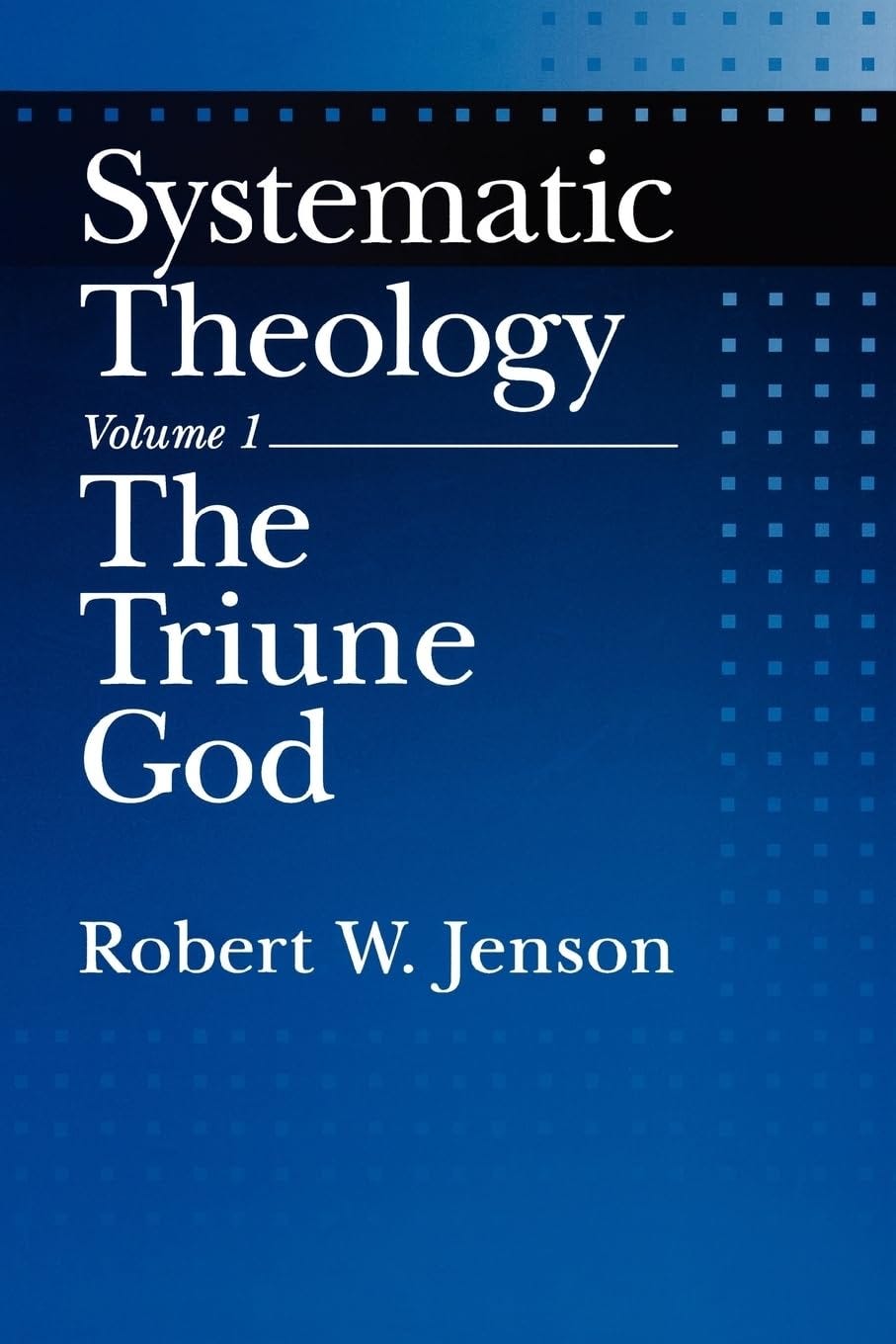
I have been reading Jenson assiduously for twenty years now (the first volume of his Systematic Theology was one of the few books I took with me when I moved to Cameroon for a year in 2006), and I think I can say there is no theologian whom I’ve kept company with more consistently in my adult life. I read Jenson for provocation, instruction, and often for comfort, though his (very good, exquisitely compressed) prose isn’t exactly warm.1
Fred Sanders has commented that as he grappled with the working out of each locus in Jenson’s Systematic Theology, “it seemed to me that he was trying to handle every single doctrine and sub-doctrine in such a way that he was saying the gospel in the very act of saying that doctrine, no matter what it was.” That perfectly captures what I have found in reading Jenson too: whether he’s writing about time, sin, church polity, sacraments, or the last judgment, he’s saying: “There has lived a man wholly for others, all the way to death; and he has risen, so that his self-giving will finally triumph.”
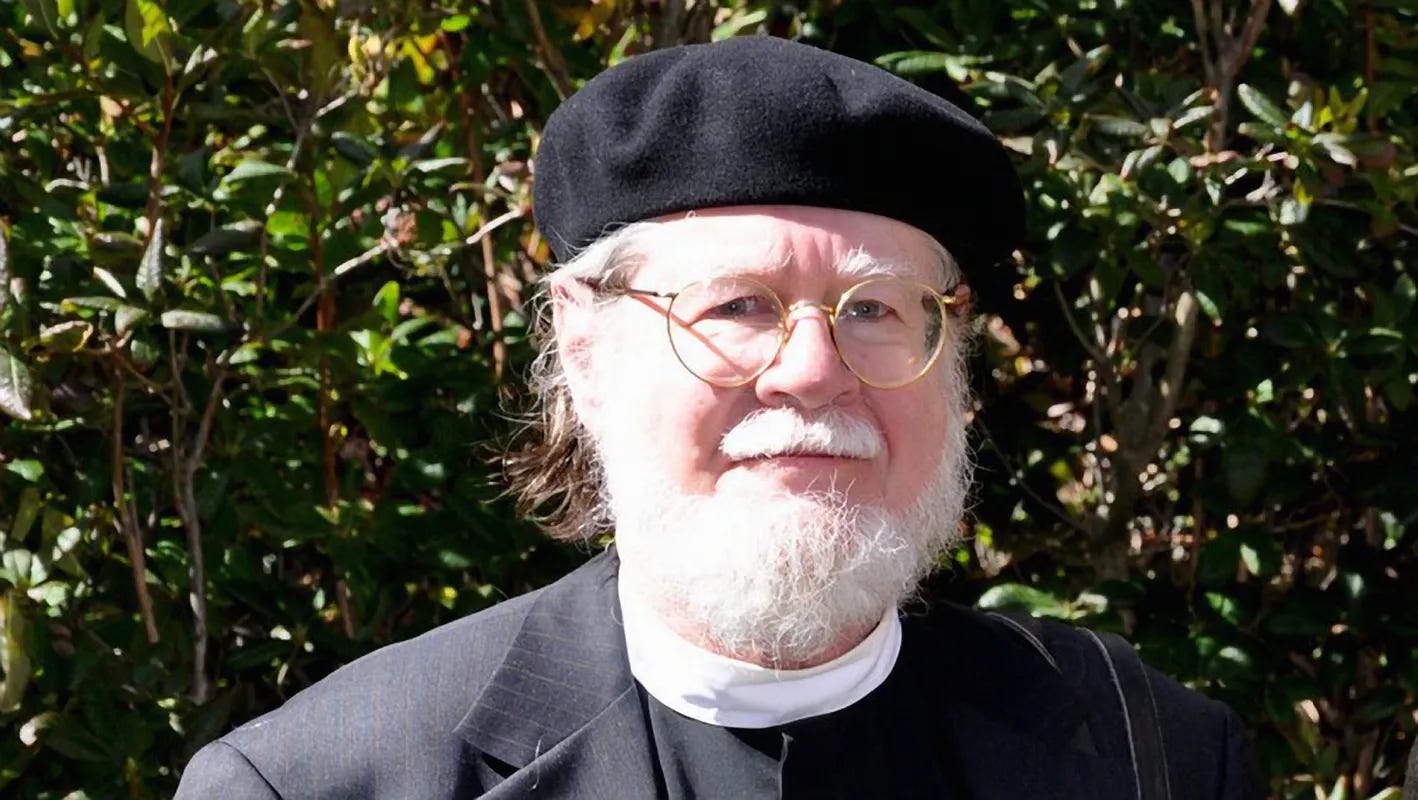
I never met Jenson, though we had mutual friends. My colleague Matt Bruce has written a lovely remembrance of him here. And my former colleague David Yeago once described to me what it was like to have Jenson as a seminary professor: “We all recognized that this was the smartest person we’d ever met, who knew all the arguments to contrary, and he just flat-out believed Jesus rose from the dead” (my paraphrase from memory).
Yeago put it more formally later, in a tribute given at the annual Center for Catholic and Evangelical Theology banquet the year Jenson died:
“For example,” [Jenson] said, “if the gospel is true, then no steady-state cosmology can be true.” He did not, to my remembrance, explicate this puzzling claim, but in context that was unimportant. I did not know much in 1980, but I had read enough to know that in making such a statement, Jenson had broken the rules. It was one of the pillars of the mainline Protestant settlement with cultural modernity that faith and theology may never contradict “science.” The outward, bodily world was the domain of secular reason and its science; theology did not make claims about that world, but only about the inner world of experience, feeling, values, and attitudes. Faith might be a stance towards the world, but it made no claims about the world. If the gospel was “true,” it had to be true in some other way. To say otherwise was to out oneself as an ignorant fundamentalist barbarian.
Yet here was Professor Jenson, clearly neither a fundamentalist nor a barbarian, fairly obviously even on first meeting the broadest and deepest intellect any of us had ever encountered, calmly asserting that the gospel was true in such a way that it could be incompatible with other claims about the way things are. Matthew Burdette and others who knew Jens later in life have recalled him saying that gospel is true “in the dumb sense,” that is, in the ordinary-language meaning of the term. In his words to us in 1980, Jens was telling us that the gospel claims that it is the case that Jesus has triumphed over death, and that his triumph has consequences for the so-called “real world.”
Notice that Jenson was speaking, not to prospective academics, but to incoming seminary juniors, candidates for the MDiv and MAR degrees. When I have talked to fellow Gettysburg alumni/ae who did not go on to be professors, but have served now for decades as parish pastors, this is also what they remember: their surprise at discovering that Jenson just believed that it was true that Jesus is risen — “in the dumb sense.” One pastor told me that his church-related-college religion professors had made it clear to him and his friends that no one who counted believed that. Before encountering Jens, he said, “We didn’t know that smart people believed that Jesus rose from the dead.”
In my experience, some of those smart people like Jenson help the rest of us go on believing it too. And he certainly has helped me proclaim it, to myself above all.
A few more things:
Here is a (detailed, illuminating) discussion of Jenson’s legacy, produced by the Center he co-founded with Carl Braaten:
I got the chance to talk with my colleague Suzanne McDonald about my Easter book a couple of months ago and respond to some questions from students and colleagues:
Markus Bockmuehl: “The resurrection is indeed a kind of religious metaphor, as is sometimes rather too blithely asserted — but its function is quite the opposite of conventional religious metaphors. From Plato’s Cave to C. S. Lewis’s Narnia, such metaphors employ the literal and familiar to speak (one hopes truthfully) of an otherworldly reality. The New Testament witness to the resurrection of Jesus, by contrast, finds only an eschatological reality adequate to describe a historical one, and only transcendent language sufficient to capture a bodily event. Heaven is no longer a metaphor of earthly bliss, or the world to come a pleasant postscript to mortality. Instead, Easter claims a newly redeemed earthly reality as a metaphor of heaven and transforms mortal life into the vestibule of paradise. Along similar lines, the resurrection resembles a myth turned inside out: for the pagan apologist Sallustius, the genius of the ancient myths is that ‘these things never happened, but always are’ (On the Gods and the World, 1). By contrast, Christian writers like Justin, Clement, and Eusebius saw the myths and philosophies of antiquity as vaguely adumbrated hopes and truths that in the incarnation and resurrection of Jesus came to real embodied fruition.”
An Eastertide observance I’m trying: When referring to “the week of…” in emails and texts about scheduling matters, I’m giving the initial date as Sunday rather than Monday, and I’m not referring to Sunday as part of the “weekend.” Just a little effort to remind myself that Sunday is “the first day of the week” (Mark 16:2). I once heard Lauren Winner say something to the effect of, “When I inhabit time more according to the Christian calendar than the national or business cycle calendars, then I’ll know I’m converted.” This is a subset of that.
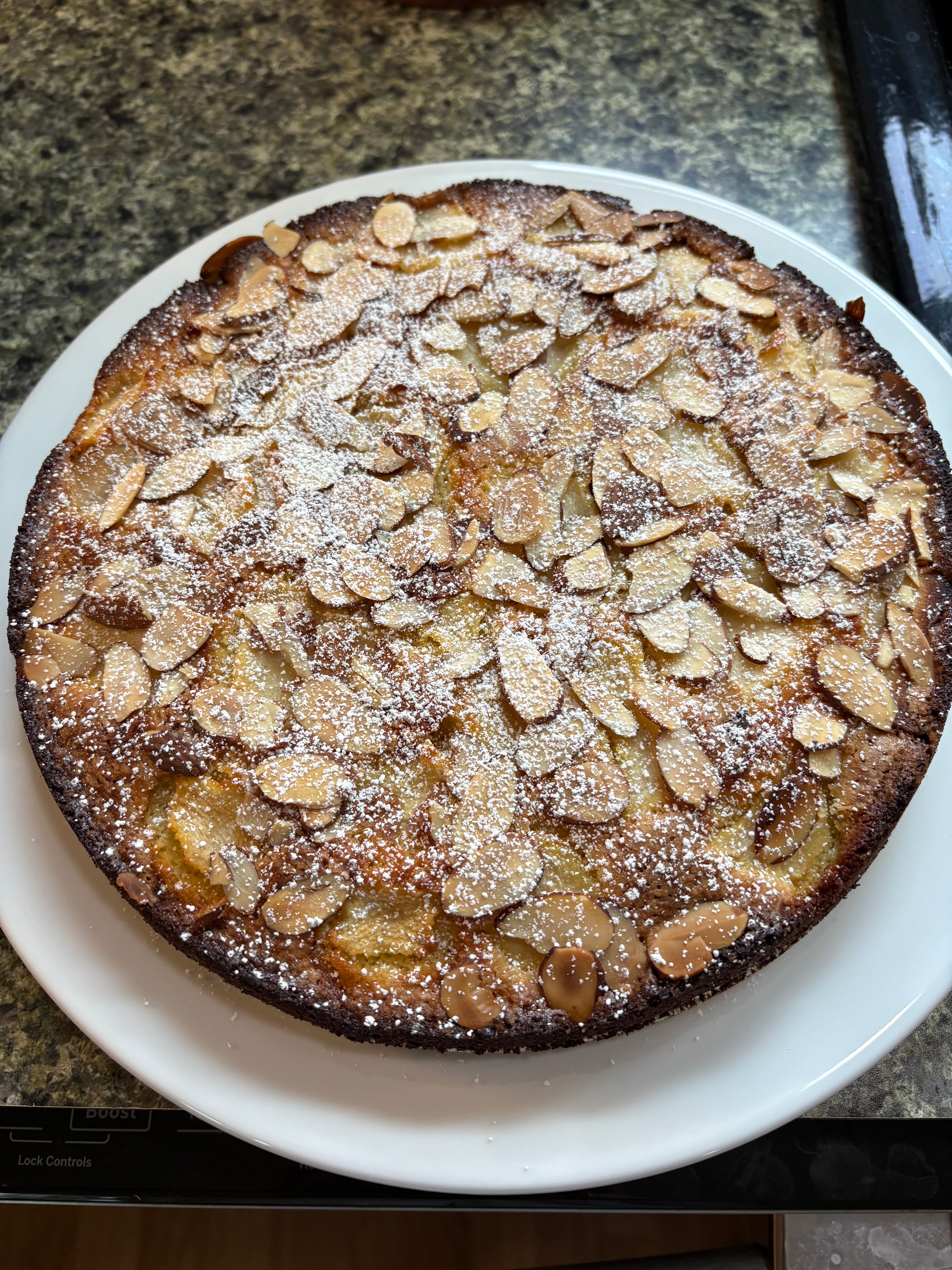
At an Easter dinner party I went to a few weeks ago, I brought this pear-almond cake. I wish I had taken the recipe’s “generously butter” the springform pan more seriously than I had, and I recommend checking it for doneness a good ten minutes earlier than the recipe says to do. But it was great; will make again, etc.
And if you happen to be in Philly next month, I’m leading a seminar on 1-3 John at the Church of the Good Samaritan in Paoli. Please consider yourself invited.
Much of Jenson’s cultural commentary is angular, even offensive, by many contemporary standards. He insists, for example, on male pronouns for God in liturgy — for theological reasons: “‘God’ is a common [not proper] name, and… therefore such sentences as ‘God sent God’s Son’ do not establish that the referent of the second ‘God’ is the same as the referent of the first, or to which divinity this ‘Son’ is related.”
Thanks for sharing this resource. On another note, I didn't know you spent a year in Cameroon. Would love to hear about that.
Thanks for this post. It's reminding me, again, that I need to read Jenson beyond a stray article/chapter/essay here and there. What's the best starter book in his collection?